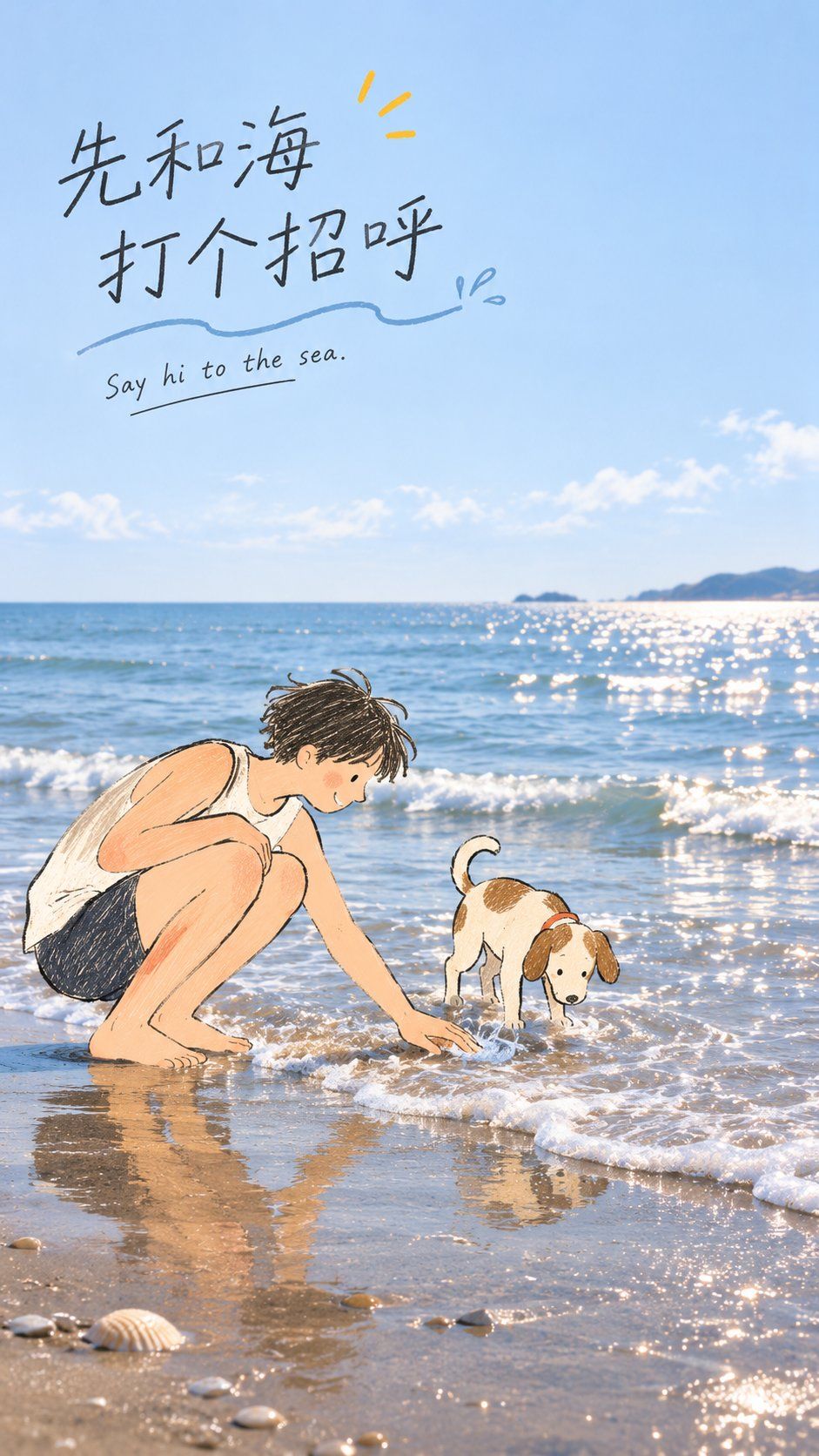
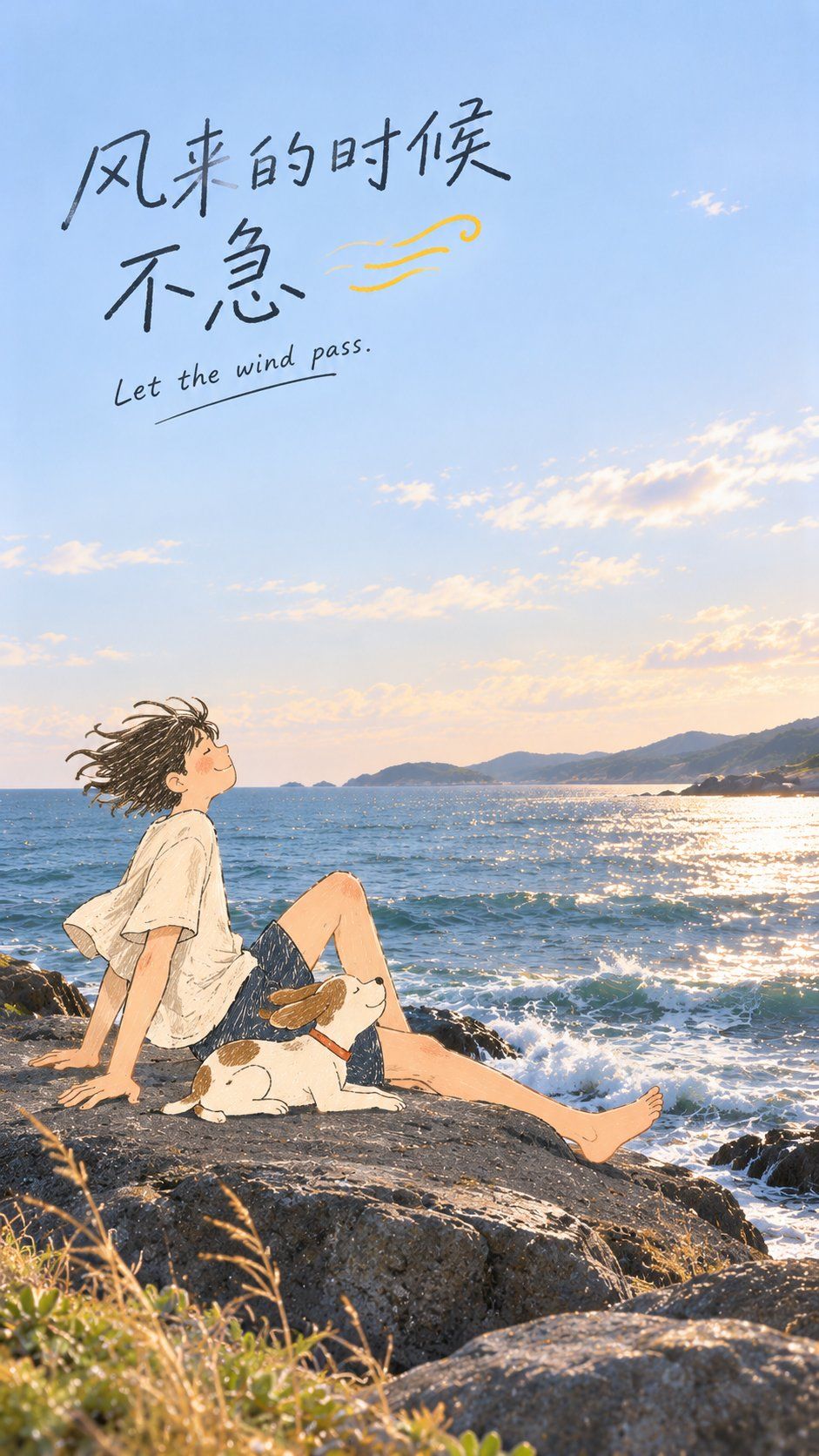
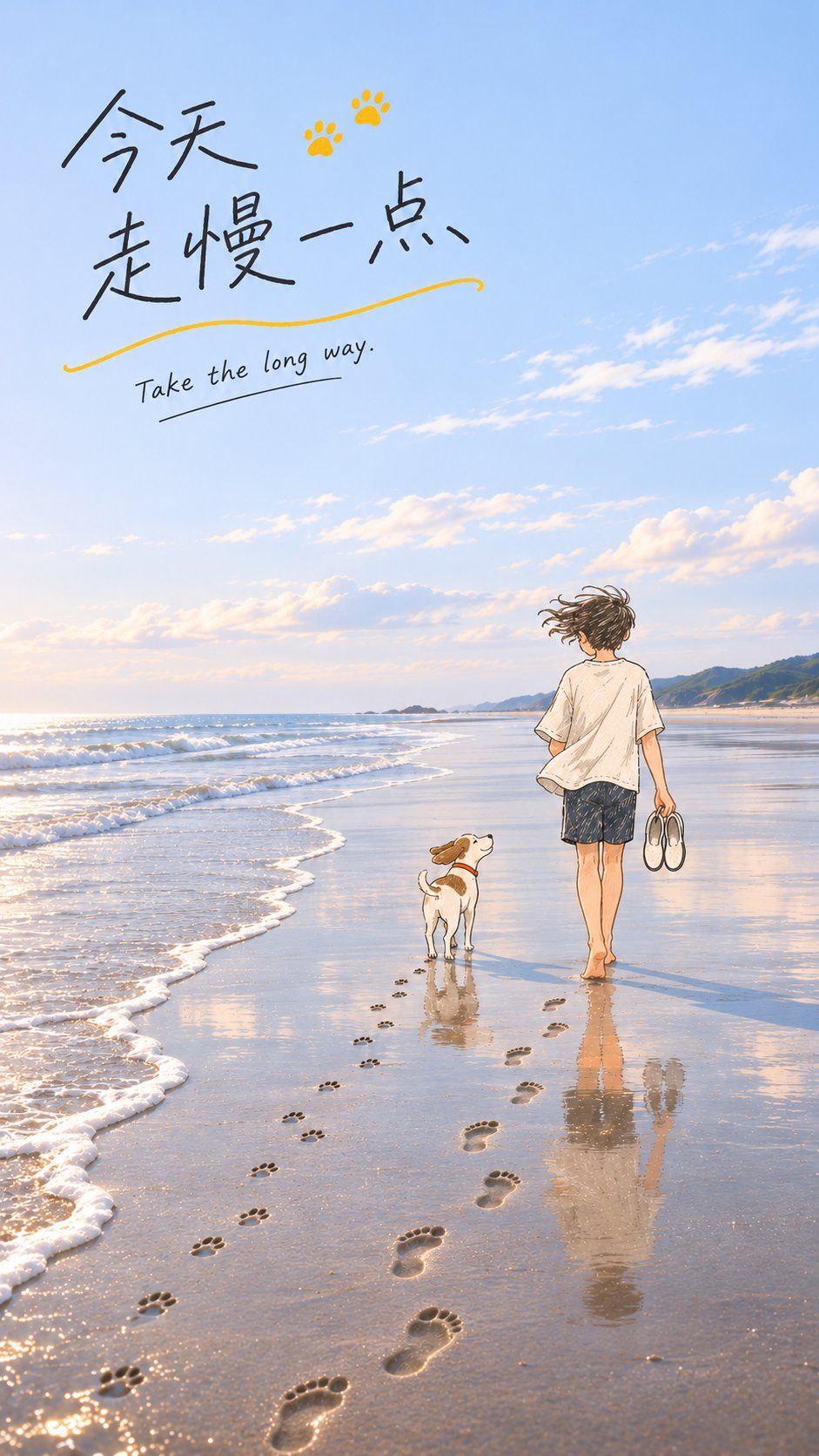
These outputs were archived from the linked source. Follow the original instructions and parameters; results can vary. How to use this archive.
Prompt
[Real scene]: {seaside / grassland / snowy landscape / lakeside / hillside / street after rain, etc.}
[Time and conditions]: {early morning / afternoon / dusk / overcast / after rain, etc.}
[Person's action]: {stretching / walking / sitting in the breeze / touching the water / watching clouds / basking in the sun, etc.}
[Dog's action]: {keeping company / following / looking back / lying down / watching the water / running, etc.}
[Main copy]: {a relaxed Chinese phrase with an everyday feel}
[Small English text]: {a brief English annotation}
[Aspect ratio]: {default 9:16}

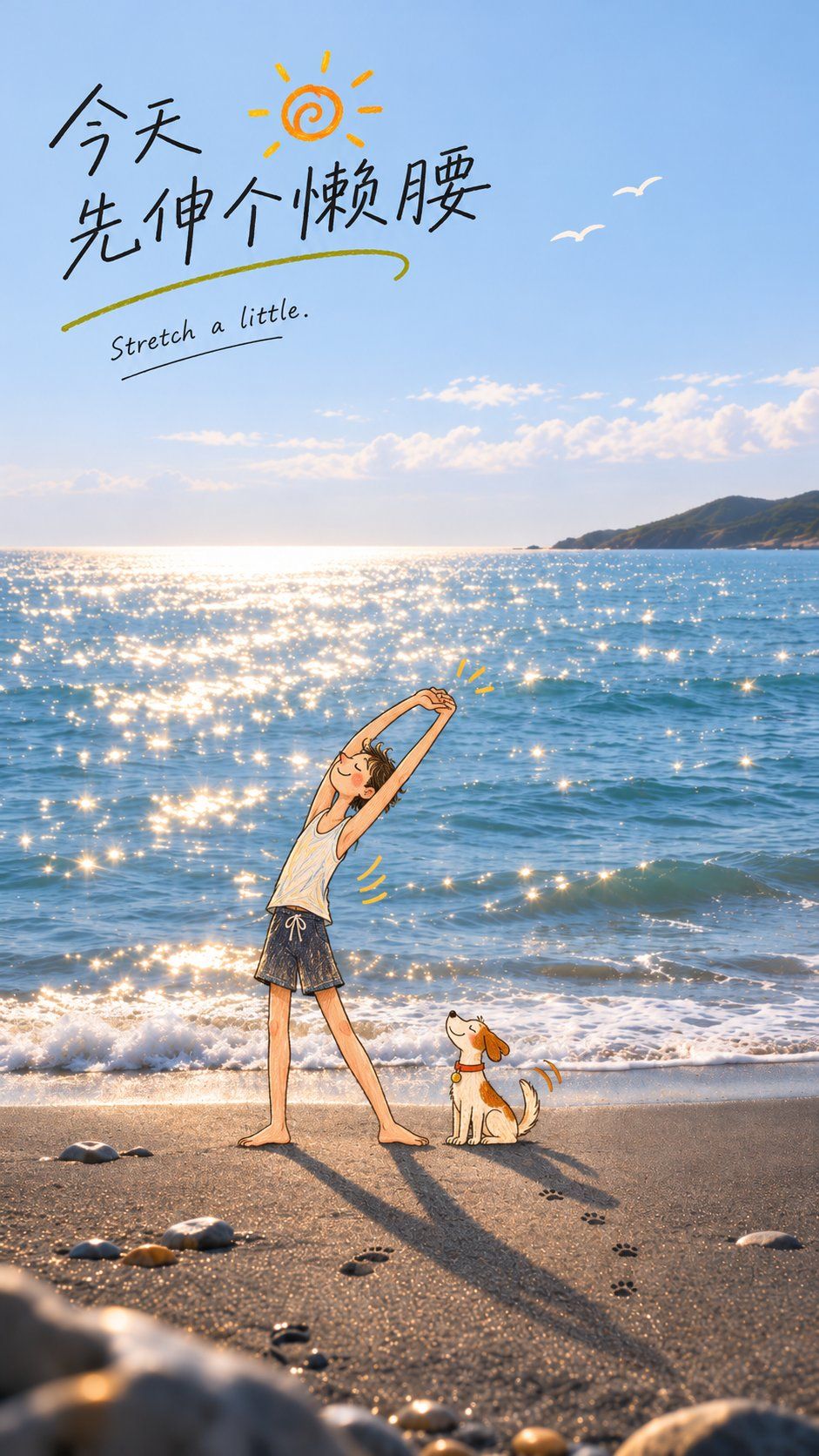
Create an atmospheric poster combining reality and imagination through “real nature photography × hand-drawn characters.”

Keep the background [Real scene] distinctly photorealistic, faithfully depicting natural light, a sense of air, the sky, ground, water, plants, rocks, rain, snow, and other environmental materials. Do not turn the entire background into an illustration.

Add a young adult rendered in a distinctly two-dimensional, hand-drawn visual language to the real environment, together with a small dog in a consistent style.

Use natural pencil outlines, slightly repeated lines, colored-pencil or crayon blocks of color, simple facial features, and elongated adult proportions for the person. No photorealistic human skin, no 3D CGI, and no oversized anime heads.

The dog should have the same clearly hand-drawn texture: a creamy-white or light beige body, brown ears and a few patches, and simple black-gray outlines. A small reddish-brown collar may be added. No realistic fur or plush-toy appearance.

The person is naturally [Person's action], while the dog is [Dog's action]. Neither looks at the camera or strikes a model's pose. It should feel like a moment accidentally captured in everyday life.

The key is to make the two-dimensional characters truly enter the three-dimensional real world, rather than lie over a photograph like stickers.

The real environment must naturally affect the person and dog. For example: seawater obscures their feet and produces ripples; wet sand retains real footprints and paw prints; blades of grass obscure their legs; rainwater creates reflections; footsteps leave depressions in snow; sunlight, tree shadows, or sunset light falls realistically on the hand-drawn characters; wind simultaneously moves the person's hair and clothing, the dog's ears, and the surrounding plants.

Keep all contact, occlusion, reflections, lighting, and directions of motion consistent, so the hand-drawn characters truly belong in this real space. Emphasize “a big world, small people” in the composition.

The real natural environment occupies most of the image. Keep the person and dog relatively small, serving only as a narrative entry point through which viewers enter the landscape. Leave ample open sky, sea, grassland, or other natural negative space. Do not make the person the main subject of a portrait.

Keep the overall visual mood quiet, relaxed, light, slightly childlike, and poetic, but not childish or filled with motivational platitudes.

Add a handwritten Chinese headline in an area of natural negative space: [Main copy]

The lettering should be natural and imperfectly regular, like a spontaneous inscription in an everyday diary or picture book. A very small hand-drawn symbol such as a sun, wind lines, a water droplet, or footprints may be added.

Below the headline, add a tiny English annotation: [Small English text]

The text serves only to convey mood and establish design hierarchy. It must not obscure the landscape or use complex commercial typography.

Let the overall palette follow the real natural environment, keeping the character colors low in saturation. Do not add lots of extra colors or decorations merely to make it look “designed.”

The final effect should feel like this: in a real, expansive world, there lives a person and a small dog drawn in pencil and colored pencil.

At first glance, the viewer sees the real landscape and atmosphere; only at second glance do they notice the hand-drawn characters genuinely living within it.

Avoid: purely illustrated backgrounds, photorealistic people, characters floating like stickers, no physical interaction between environment and characters, complex commercial posters, excessive decorative text, excessive cartoon styling, motivational platitudes, and information overload.
【真实场景】:{海边 / 草地 / 雪地 / 湖边 / 山坡 / 雨后街道等}
【环境时刻】:{清晨 / 午后 / 黄昏 / 阴天 / 雨后等}
【人物动作】:{伸懒腰 / 散步 / 坐着吹风 / 摸水 / 看云 / 晒太阳等}
【小狗动作】:{陪伴 / 跟随 / 回头 / 趴着 / 看水 / 奔跑等}
【主文案】:{一句轻松、有生活感的中文短句}
【英文小字】:{一句简短英文旁注}
【画幅比例】:{默认 9:16}
创作一张「真实自然摄影 × 手绘人物」虚实结合的情绪海报。
背景【真实场景】保持明显的摄影级真实质感,真实表现自然光、空气感、天空、地面、水面、植物、岩石、雨雪等环境材质,不要将整个背景插画化。
在真实环境中加入一位明显采用二维手绘语言表现的年轻成年人,以及一只固定风格的小狗。
人物使用自然铅笔轮廓、轻微重复线条、彩铅或蜡笔色块、简洁五官和修长成年人比例。不要真人写实皮肤,不要 3D CGI,不要动漫大头。
小狗保持同样明显的手绘质感:奶油白或浅米色身体、棕色耳朵和少量斑纹、简单黑灰轮廓,可加入小型红棕色项圈。不要写实毛发或毛绒玩具感。
人物正在自然地【人物动作】,小狗同时进行【小狗动作】。两者都不看镜头,不摆模特姿势,像真实生活中被偶然记录的一瞬间。
核心是让二维角色真正进入三维现实世界,而不是像贴纸一样覆盖在照片上。
真实环境必须自然影响人物和小狗,例如:海水遮挡脚部并产生波纹;湿沙留下真实脚印和爪印;草叶遮挡腿部;雨水形成倒影;雪地被脚踩出凹陷;阳光、树影或夕阳真实落在手绘角色身上;风同时吹动人物头发、衣角、小狗耳朵和周围植物。
所有接触、遮挡、倒影、受光和运动方向保持一致,让手绘角色真正属于这个真实空间。构图强调「大世界,小人物」。
真实自然环境占据画面主要面积,人物和小狗保持相对较小,只作为观众进入风景的故事入口。保留充足天空、海面、草地或其他自然留白,不要把人物做成人像主体。
整体视觉保持安静、松弛、轻盈、有一点童心和诗意,但不要幼稚或鸡汤。
在自然留白区域加入中文手写标题:【主文案】
字体自然、不完全规整,像生活日记或绘本中的随手题字。可加入一个很小的太阳、风线、水滴、脚印等手绘符号。
标题下方加入极小的英文旁注:【英文小字】
文字只承担情绪和设计层次,不遮挡风景,不使用复杂商业排版。
整体色彩跟随真实自然环境,人物颜色保持低饱和。不要为了“设计感”加入大量额外颜色和装饰。
最终效果应该像:一个真实、辽阔的世界里,住着一个铅笔和彩铅画出来的人和一只小狗。
第一眼看到真实风景和氛围,第二眼才发现手绘角色正在真实地生活在其中。
避免:纯插画背景、写实人物、人物像贴纸悬浮、环境与角色没有物理互动、复杂商业海报、大量装饰文字、过度卡通、鸡汤文案和信息过载。